
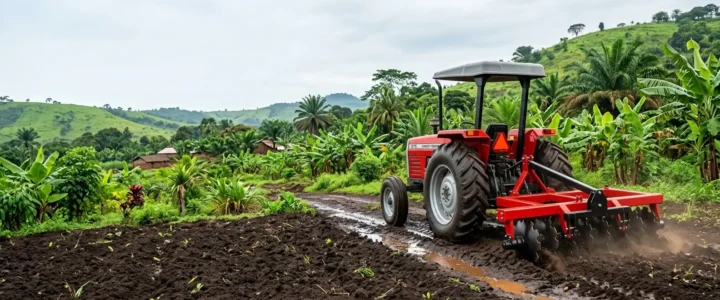
For most farms in the Democratic Republic of the Congo, a 4WD tractor is the better choice because it handles muddy, hilly, and uneven terrain far more reliably than a 2WD model. However, 2WD tractors remain a cost-effective option for farmers working flat, dry land with lighter soil types. The right choice ultimately depends on your farm’s terrain, soil conditions, and budget.
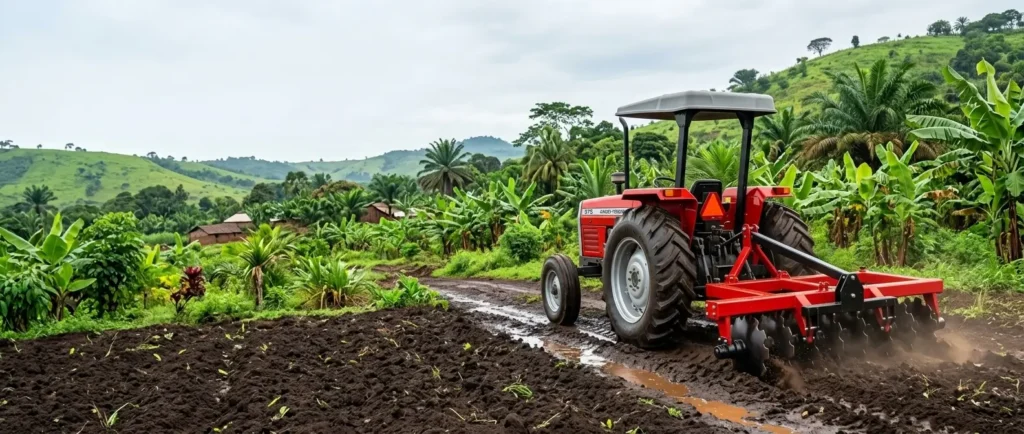
What Is the Difference Between 2WD and 4WD Tractors?
A 2WD (two-wheel drive) tractor only powers its rear wheels, while a 4WD (four-wheel drive) tractor powers all four wheels simultaneously. This difference in power distribution directly affects traction, stability, and performance across different ground conditions—a critical factor for farmers operating in the DRC’s varied terrain.
Why Terrain Matters When Choosing a Tractor in DRC
The DRC’s agricultural regions include a mix of rainforest clearings, hilly plateaus, and seasonally wet lowlands. These conditions often produce soft, muddy, or sloped ground, particularly during the rainy season.
- 4WD tractors distribute power across all four wheels, reducing wheel-slip and improving grip on muddy or uneven ground.
- 2WD tractors can struggle in wet or loose soil, as power is concentrated on the rear wheels only, increasing the risk of getting stuck.
For farmers working in hilly or rain-affected regions of the DRC, a 4WD tractor is generally better suited to maintaining consistent traction and productivity year-round.
Is a 2WD Tractor Still a Good Option for DRC Farmers?
Yes—2WD tractors are better suited for farms with flat, firm, and well-drained land, where the extra traction of a 4WD system isn’t essential. They are typically more affordable to purchase and maintain, making them a practical option for smaller-scale farmers or those with tighter budgets. Models like the Massey Ferguson MF-135 and MF-165, both available through Tractor Provider, are reliable examples of dependable 2WD tractors suited to lighter workloads.
Cost Comparison: 2WD vs 4WD Tractors
- 2WD tractors: Lower upfront cost, simpler mechanics, cheaper parts and maintenance.
- 4WD tractors: Higher upfront investment, but improved traction can reduce downtime and repair costs caused by wheel-slip damage or getting stuck in difficult terrain.
Farmers should weigh the long-term productivity gains of 4WD against the lower initial cost of 2WD when budgeting for new machinery.
Which Tractor Type Does Tractor Provider Recommend for DRC Farms?
Tractor Provider recommends 4WD models—such as the Massive 290 4WD Tractor or Massey Ferguson MF-6120/4WD—for farmers working on hilly, wet, or inconsistent terrain, which describes much of the DRC’s farmland. For farms on flatter, drier ground, 2WD models offer excellent value without sacrificing reliability. Explore the full range of tractors available in the DRC to compare models suited to your specific farm conditions.
Frequently Asked Questions
Can a 2WD tractor be converted to 4WD?
No, 2WD and 4WD tractors have fundamentally different drivetrain systems, so conversion isn’t practical or cost-effective. It’s best to select the right drivetrain at the point of purchase based on your farm’s terrain.
Do 4WD tractors use more fuel than 2WD tractors?
Generally, yes—4WD tractors consume slightly more fuel due to powering all four wheels, but this is often offset by improved efficiency and reduced wheel-slip in difficult conditions.
Are used 4WD tractors available in the DRC?
Yes, Tractor Provider stocks both new and used 4WD tractors, including Kubota and Massey Ferguson models, offering a more budget-friendly way to access 4WD capability.